 YouX Prime
 Schedule Consultation
YouX Prime Private Equity's standard playbook relies on Technical Due Diligence to de-risk a product asset. Tech DD audits code maintainability and security. It does not audit the design operations that set shipping velocity or determine whether the team behind the interface is stable enough to hit the roadmap the exit narrative depends on. That gap isn't theoretical — it shows up on the income statement, and it compounds every quarter it goes unmeasured.
Following two years of tech contraction, companies flattened org charts, and the first roles cut were the ones with no direct line to a shipped feature — DesignOps, UX research, and design-systems governance. When a specialized function gets absorbed into generalists, your organization carries concentrated key-person risk.
SHRM and Gallup put the fully-loaded cost of replacing a specialized employee at 50–200% of annual salary. A single unplanned departure is a $65K–$320K unbudgeted hit. That's the number a Tech DD code audit will never show you, because it isn't in the codebase. It's in the org chart.
The true cost of losing DesignOps isn't paid by the design department. It's paid by engineering, in rework. Independent industry surveys report that teams without dedicated governance lose a quarter to half of their time to handoff breakdowns.
In one recent engagement, a full audit of 4,183 Jira issues found that 46% of all design work sat idle in pre-production planning before a single asset was touched — because nobody was measuring where the actual bottleneck was.
Nielsen Norman Group's UX Maturity Model states plainly that most organizations plateau in the middle stage: functioning acceptably, but never advancing to structured governance. They have design teams. They do not have design operations.
The Reality: If your portfolio company doesn't know where its bottleneck is, you're paying full salary for engineers burning cycles on friction nobody's measuring. It's invisible to Tech DD until a buyer's diligence team finds it and prices it into the offer.
We close the gap between standard Technical Due Diligence and actual product design organization health. We deploy institutional velocity protocols to translate subjective "UX problems" into measurable financial impacts.
Behavioral Validation First: If an acquired product is fundamentally misaligned with user behavior, fixing the interface structure won't save the valuation. We audit the foundational "Jobs to be Done" and behavioral mechanics before looking at Object-Oriented UX.
The Meeting Pusher Problem: Traditional DPMs aren't craft experts — they report timelines but can't tell if a designer is genuinely blocked. A pure designer doesn't read organizational dynamics. We audit the structural reality because we've led both the craft and the design org.
Independent Exit Protection: Portfolio company leadership has incentives to present optimistic narratives. We provide a third-party assessment with no incentive to prolong engagements. We document that your asset meets institutional standards before the buyer arrives.
We deploy a systematic framework to assess, quantify, and remediate product organization risk:

We audit the operational systems that reveal organizational health:
Deliverable: Objective risk scorecard with benchmarked findings

We translate operational dysfunction into financial impact:
Deliverable: Board-ready intelligence with capital efficiency analysis
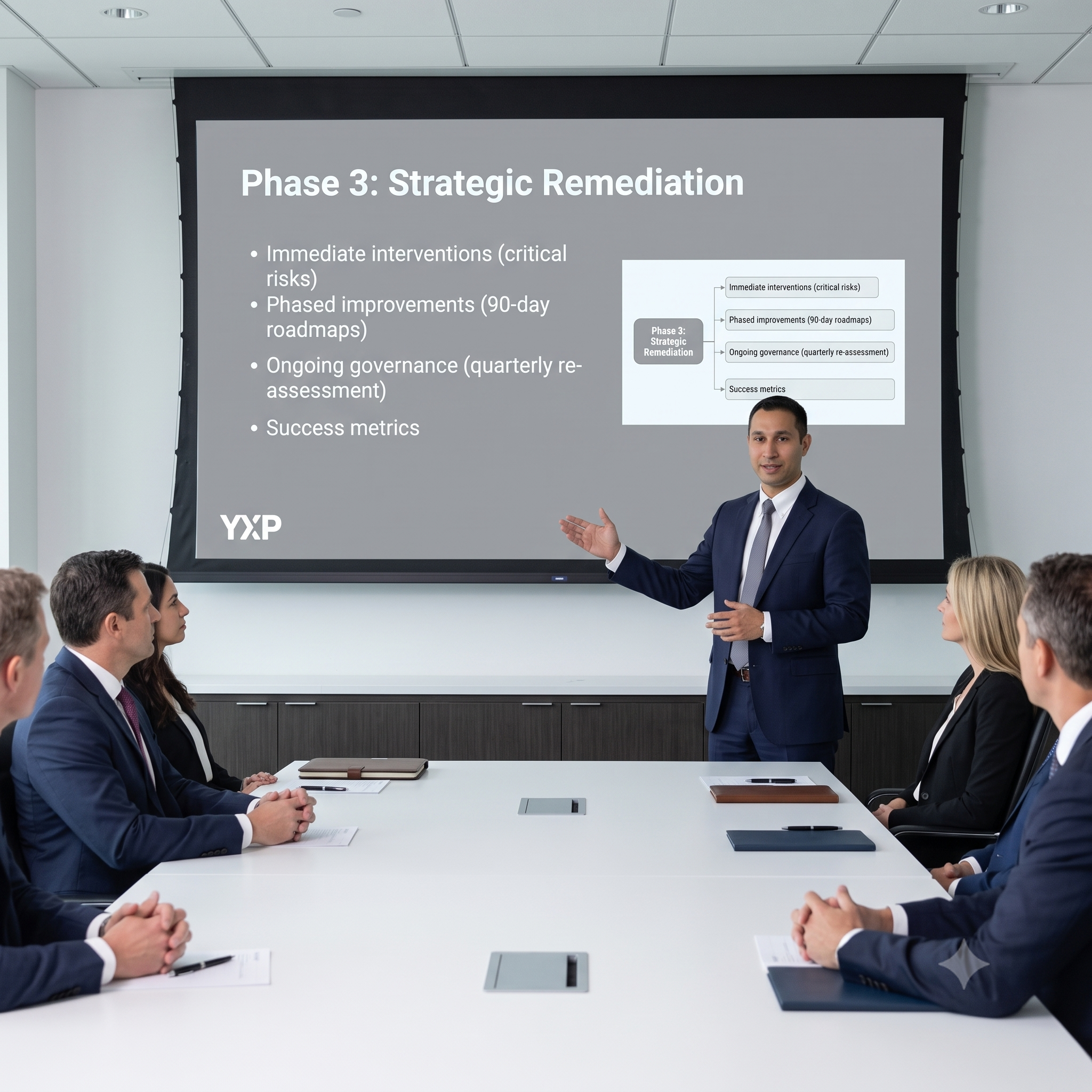
We provide clear, prioritized action plans:
Deliverable: Executable roadmap with resource requirements and timelines
The Result: You gain independent verification of product design organization health, early warning on threats to the exit multiple, and actionable intelligence to inform capital allocation.
Select the engagement model that matches your portfolio oversight needs:
For: PE firms managing multiple portfolio companies requiring continuous oversight
Structure: Annual retainer with quarterly touchpoints
What You Get:
Use Case: Standard risk management for stable portfolio companies preparing for eventual exit
For: Portfolio companies 12-18 months from planned strategic sale
Structure: One-time comprehensive intensive (12-week engagement)
What You Get:
Use Case: Mitigate valuation adjustment risk before acquirers conduct due diligence
For: Due diligence teams evaluating acquisition targets
Structure: Rapid assessment during deal flow (15-30 business days)
What You Get:
Use Case: Complement financial DD with product intelligence to prevent surprises
Executive Risk Briefing: Compressed 48-hour assessment for one portfolio company. Confidential risk scorecard delivered directly to you. Credit applied if you proceed to full engagement within 30 days.
Schedule BriefingDepending on engagement scope, you receive executive-level documentation designed for your Board and investment committee:
Visual heat maps showing velocity efficiency, human capital stability, technical debt levels, and organizational maturity—benchmarked against established maturity frameworks.
Dependency mapping identifying critical knowledge concentration, succession gaps, and flight risk probability with recommended mitigation protocols.
Where ticket-level data supports it, quantification of wasted engineering capacity and velocity gaps translated into dollar impact.
Certification-grade reports that demonstrate to strategic acquirers your asset meets institutional buyer standards for product organization stability.
Trend analysis showing improvement or degradation across risk vectors, allowing you to track remediation effectiveness and identify emerging issues.

Credentials:
Institutional Background:
Our assessment methodologies are developed from institutional operational experience (Amazon, Sony, Paychex, Blizzard), then applied to mid-market portfolio oversight.
The Value: Enterprise knowledge without enterprise bureaucracy. We apply the operational rigor of billion-dollar platforms to your $50M-$200M portfolio companies.
Your internal team reports to the CEO. Their incentive is to protect internal reputations and avoid uncomfortable truths about underperformance. We report to you—the capital allocator. Our incentive is to protect your exit multiple, even if that means delivering uncomfortable data about leadership gaps or imminent talent flight. This is the same reason you use external financial auditors instead of asking the CFO to audit themselves. Independent verification is structural, not personal.
Agencies are incentivized to prolong engagement and sell production hours. YouX Prime is an oversight function. We audit agencies and internal teams to verify they're delivering value aligned with your investment thesis. We don't design the assets; we verify the assets are built for capital efficiency and exit readiness.
There are three distinct layers here: Technical DD evaluates code quality. Product DD evaluates roadmap and market fit. We evaluate the DesignOps layer: the operational system that determines whether the org can actually execute at the velocity, quality, and stability the exit narrative depends on.
Tech DD tells you if the code is maintainable. Product DD tells you if the strategy is sound. We tell you if the team and system built to ship that strategy is stable. These three assessments are orthogonal, not competing.
We audit operational systems, not opinions. We access raw data—Jira velocity metrics, Figma usage patterns, design system analytics—and use those findings in combination with supported observable evidence. Our frameworks are informed by building operational systems at Amazon, Sony, and Paychex that processed billions in transactions. We apply institutional-grade rigor to mid-market assessments.
No. We provide independent assessment and advisory services based on rigorous methodologies. Our role is to provide objective intelligence to inform your decisions. Final strategic and personnel decisions remain solely with you. While we apply financial modeling to demonstrate potential impact, these are illustrative estimates, not guarantees.
We require observer-level (read-only) access to project management tools (Jira, Linear, Asana), design systems (Figma), and product staging environments, along with availability for confidential stakeholder interviews (45 minutes each with CTO, VP Product, Lead Designer). All findings are reported exclusively to you. You control the information flow.
Engagement structure and investment levels are determined during initial consultation based on portfolio composition, complexity factors, and oversight requirements. We provide transparent fixed-fee proposals with clear deliverables and timelines. Volume arrangements are available for PE firms deploying governance across multiple portfolio companies.
Absolutely. Most PE firms begin with a single engagement to establish methodology. Upon successful completion, expansion to additional portfolio companies typically occurs within 3-6 months. We also offer a compressed Executive Risk Briefing as an entry point.
For PE Operating Partners managing B2B SaaS, FinTech, or PropTech portfolios.
If any of the following apply, we should talk:
Initial Consultation Includes: Portfolio composition review, highest-risk asset identification, engagement model recommendation, sample deliverable review, and transparent fee structure discussion.